English
 Español
 Português
 русский
 Français
 日本語
日本語 Deutsch
 tiếng Việt
 Italiano
 Nederlands
 ภาษาไทย
 Polski
 한국어
한국어 Svenska
 magyar
 Malay
Malay বাংলা ভাষার
 Dansk
Dansk Suomi
Suomi हिन्दी
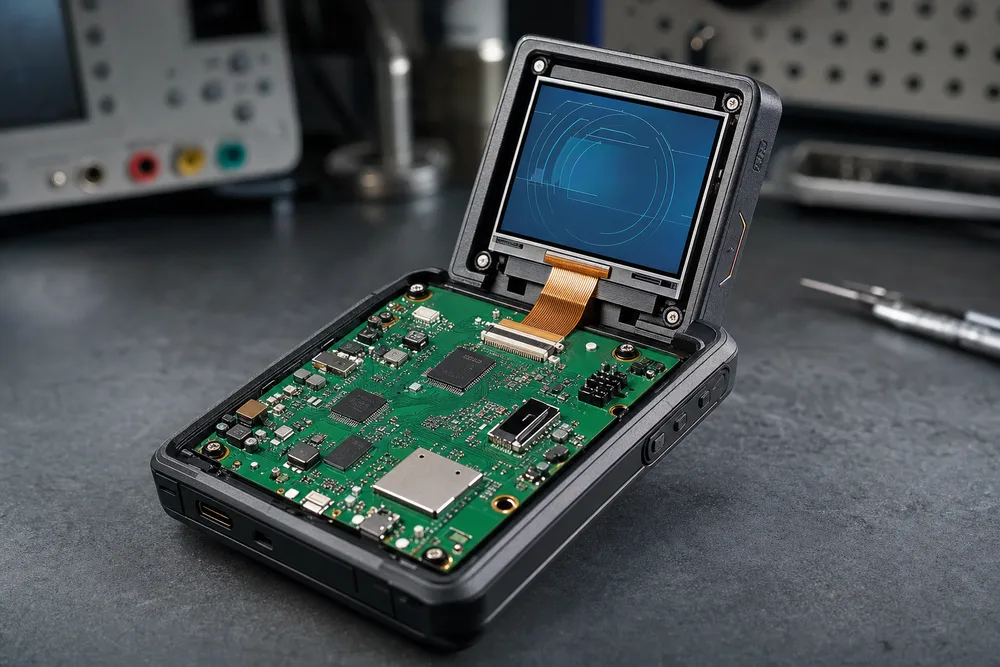
A 2.3-inch display can be a surprisingly expensive part to change after the enclosure, host board, and boot-up sequence are already frozen. The HONGJIA HJ2290-02FPC-A1 2.3-inch MIPI LCD is a 480(RGB)×360 IPS TFT module aimed at compact equipment where viewing angle, pixel density, and a small physical footprint all matter. Before you put it on a BOM, confirm the host can drive its interface, the FPC fits the board stack-up, and the production program can support your actual lifecycle.
Key Takeaways: What U.S. Buyers Should Confirm Before Selecting This 2.3-Inch MIPI LCD
- HJ2290-02FPC-A1 is specified as a 2.3-inch IPS TFT Liquid Crystal Display with 480(RGB)×360 resolution, MIPI interface, 24-pin connection, ST7701S driver IC, and white LED backlight.
- Do not treat “MIPI” as a universal fit. Your processor, display serial interface configuration, initialization sequence, and connector strategy must be checked against the current product specification.
- The stated operating and storage range is -30 to 80°C, but system-level thermal performance still depends on the enclosure, backlight use, and nearby heat sources.
- Ask early about samples, small-order support, safe stock, touch requirements, and long-term supply expectations.
U.S. design teams often start with resolution and diagonal size. That is understandable, but it misses the usual trouble spots. The costly questions are electrical and mechanical: Does your SoC expose a usable MIPI display interface? Can the 24-pin FPC reach the board without a sharp fold or connector interference? Does your firmware team have the correct panel initialization information? A display that looks right in a CAD rendering can still delay a pilot build if any one of those answers is vague.
IPS (in-plane switching) is the panel technology that keeps liquid-crystal molecules rotating largely within the plane of the substrate under drive. In practice, it is selected for more consistent off-axis viewing than older narrow-viewing-angle TFT modes. It does not eliminate the need to validate brightness, contrast, color appearance, and reflections in the finished product. A glossy cover lens, dark enclosure cavity, or strong ambient light can dominate what the user sees.
HJ2290-02FPC-A1 Specifications: 2.3-Inch IPS TFT LCD Module at a Glance
The published description identifies this module as a 2.3-inch IPS TFT LCD module with 480(RGB)×360 pixels. The RGB designation means each displayed pixel is composed of red, green, and blue subpixels. That resolution is useful for compact instrument screens, handheld controls, smart-home interfaces, POS equipment, and other products that need readable graphics without moving to a larger display opening.
HONGJIA lists an ST7701S driver IC, MIPI interface, 24 pins, and white LED backlight. Those facts define the starting point, not the whole integration package. Pixel format options, lane arrangement, power rails, reset behavior, timing limits, FPC dimensions, active area, outline, luminance, and optical specifications should come from the current drawing and datasheet for the exact revision you intend to buy.
| Parameter | Published information | Design-in check |
|---|---|---|
| Display type | 2.3-inch IPS TFT LCD module | Assess viewing angle and finished-product optics. |
| Resolution | 480(RGB)×360 | Confirm framebuffer, UI scaling, and image assets. |
| Interface and driver | MIPI; ST7701S driver IC | Verify host support and initialization requirements. |
| Connection and backlight | 24 pins; white LED backlight | Check connector, FPC routing, and backlight control. |
| Temperature range | -30 to 80°C operating and storage | Validate actual enclosure and duty-cycle temperatures. |
FAQ: What Do LCD, TFT, IPS, MIPI, and Driver IC Mean for a Display Design?
LCD is the light-controlling panel technology; TFT is the active-matrix transistor layer that addresses pixels; IPS is the viewing-angle-oriented LCD mode; MIPI is the high-speed display interface family; and the driver IC converts host commands and image data into panel timing and pixel drive. Each term affects a different part of your design.
A TFT liquid crystal display needs a backlight because the liquid-crystal layer does not generate its own light. Here, the listed white LED backlight must be treated as a system component: confirm its control method, expected operating conditions, and the thermal path around the display cavity. The ST7701S is the module’s named driver IC. Your firmware work may involve reset sequencing, command configuration, sleep and wake behavior, and panel-specific settings. Do not assume a driver written for another ST7701S-based panel will work unchanged; panel glass, timing configuration, and vendor initialization tables can differ.
MIPI is efficient for compact high-resolution displays, but it asks more of the host board than a simple parallel interface. Signal routing, host controller availability, software support, and electromagnetic behavior should be reviewed as one package. A MIPI label on the display does not guarantee that every MIPI-capable processor board can use it without adaptation.
FAQ: How Can Engineers Verify Host Compatibility, FPC Integration, and MIPI Support?
Get the current HJ2290-02FPC-A1 specification package, then compare its electrical, interface, timing, mechanical, and software requirements against your exact host board and enclosure before ordering production material. This is a review task for hardware, firmware, mechanical, and sourcing—not a purchasing checkbox.
- Confirm the host interface. Establish that the processor or bridge IC supports the required MIPI display mode and has a software path for the panel.
- Review the panel documentation. Match power-up behavior, reset and enable signals, command set, display timing, and driver initialization information to the host implementation.
- Inspect the FPC path. Check the 24-pin FPC orientation, mating connector, bend area, insertion access, strain relief, and clearance to battery packs, shields, or enclosure ribs.
- Build with a sample. Test cold start, repeated sleep/wake cycles, full-white operation, UI content, and the actual cover lens before locking tooling.
The overlooked failure mode is usually mechanical. FPCs are not forgiving of an aggressive bend directly at the connector, and a cable that was easy to install on an open bench can become inaccessible after the housing is assembled. Use the supplier drawing rather than estimating the outline from a product photo. If your application needs a touch surface, ask about the complete touch LCD or CTP arrangement early; adding it late can change stack height, cover-lens bonding, and optical behavior.
Why HONGJIA Supports Small- and Medium-Sized Display Design-In Programs
HONGJIA focuses on small- and medium-sized TFT liquid crystal displays, LCD modules, touch LCD/CTP products, long-strip LCDs, and OLED displays from 1.14 inches through 15 inches. That range matters to product teams whose display requirement may shift during development: a compact IPS module for a handheld device today, a touch variant or a different format for the next enclosure revision.
For the HJ2290-02FPC-A1, the practical advantage is access to a supplier that discusses customized solutions, FPCs, backlights, touch screens, driver ICs, small orders, safe stock, and long-term stable supply. Those are the topics that determine whether a display program survives beyond the first prototype. Small quantities can support engineering validation, while safe-stock and supply discussions matter once a product reaches service and replacement demand.
There is a limit to what any catalog listing can answer. A published module page cannot approve your connector, validate your regulatory plan, or guarantee that a future mechanical change will preserve optical performance. Treat the 2.3-inch 480×360 MIPI display listing as the correct starting point, then put your application, forecast, and control-of-change expectations in writing.
Request HJ2290-02FPC-A1 Specifications, Samples, or a B2B/B2C Quote
Start the request with the exact model number, HJ2290-02FPC-A1, and identify whether you are evaluating a prototype, a replacement display, a pilot run, or recurring production. Include the end product, estimated annual demand if known, target ship-to location, host processor or board, preferred connector arrangement, touch requirement, and expected environmental exposure. That information lets the supplier address the real fit instead of responding with a generic display quote.
For B2C replacement or maker-oriented purchases, confirm revision compatibility before assuming that two displays with the same diagonal size will interchange. For B2B programs, ask about sample availability, quotation terms, safe-stock options, supply continuity, and documentation control. A lower unit price is not a win if a changed FPC, altered initialization sequence, or unavailable replacement unit forces a board revision.
Ask for the Product Specification Before Confirming Electrical, Timing, Optical, or Mechanical Requirements
Request the current specification, outline drawing, interface information, and any available initialization guidance before releasing your schematic, PCB, or tooling. Use those documents to confirm the requirements that are not stated on the public product page, including electrical limits, signal timing, luminance and viewing details, dimensions, active area, connector definition, and FPC handling guidance.
Discuss End-Product Compliance Needs, Including Applicable UL, CE, RoHS, or FCC Requirements
Tell HONGJIA which market and end-product rules apply, then determine what module-level documentation is available and what must be verified at the finished-product level. UL, CE, RoHS, and FCC are not interchangeable display certifications. FCC commonly concerns electromagnetic emissions for the finished electronic product, while CE obligations depend on the product and applicable directives. Do not claim compliance from a display module alone without reviewing the full system.
Get the HJ2290-02FPC-A1 Design-In Details
Request the current specification package and sample or quote information before you commit the host interface, FPC connector, enclosure, or production BOM.
Visit Official Website →