 English
 Español
 Português
 русский
 Français
 日本語
日本語 Deutsch
 tiếng Việt
 Italiano
 Nederlands
 ภาษาไทย
 Polski
 한국어
한국어 Svenska
 magyar
 Malay
Malay বাংলা ভাষার
 Dansk
Dansk Suomi
Suomi हिन्दी
Why Choose a 1500-Nit 7-Inch IPS Display for Outdoor Equipment?
Walk onto any active construction site or agricultural survey field, and you will see operators doing the exact same thing: cupping their hands over their equipment screens to block the sun. They are trying to read critical data on displays that were never designed for direct ambient light. A standard 300-nit consumer screen simply acts as a dark mirror under a clear midday sky.
If you are engineering outdoor hardware, throwing a brighter backlight at a cheap panel is not enough. You need raw luminance to overpower surface reflection, high pixel density to render complex schematics legibly, and a viewing angle that does not degrade when the device is mounted on a dashboard or held at waist level. The shortest path to solving this triad of problems is specifying a 7 inch IPS Display 1200x1920 with a 1500-nit backlight.
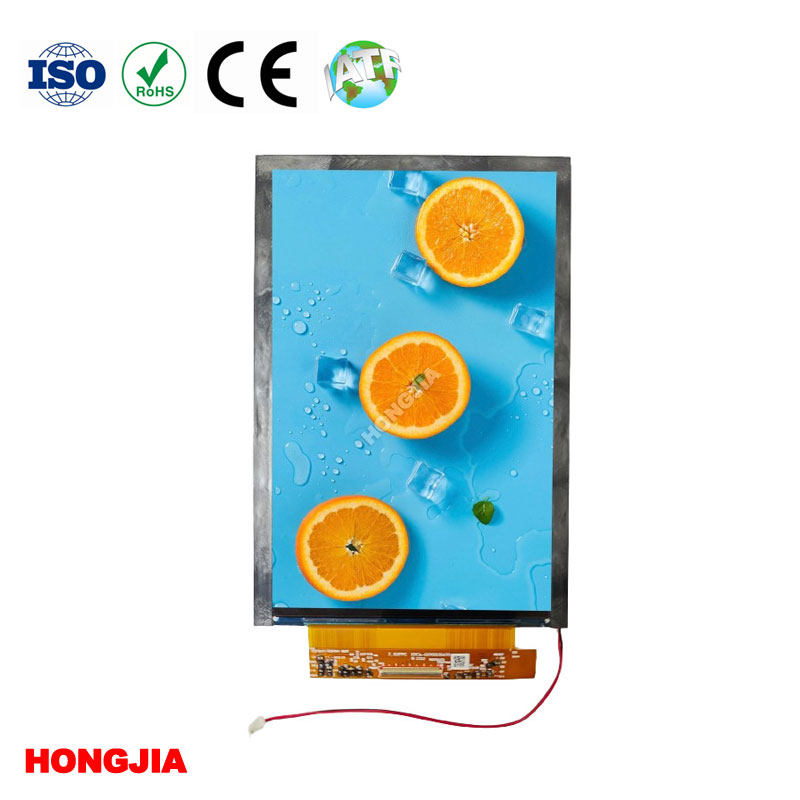
This configuration—specifically models like the HONGJIA HJ7020-01—pairs ultra-high brightness with a dense portrait-oriented pixel matrix. It gives operators immediate readability in the field without forcing them to hunt for shade. But integrating a display with this much output requires careful attention to interface bandwidth, thermal management, and power draw.
The Readability Gap: Why Standard 1024x600 Screens Fail in Sunlight
Most legacy industrial equipment relies on standard 7-inch panels with a 1024x600 resolution and a brightness hovering between 350 and 500 nits. Indoors, this specification is perfectly adequate. Outdoors, it fails entirely.
Direct sunlight regularly exceeds 10,000 lux, and on a bright, cloudless day, it can push past 100,000 lux. When that much ambient light hits the cover glass of a display, the screen reflects a significant percentage of it right back at the viewer. If the display's internal backlight cannot emit enough photons to outcompete that surface reflection, the contrast ratio collapses to near zero. The screen washes out. Text disappears into a grey haze.
Resolution compounds the issue. A 1024x600 screen spread across 7 inches yields a low pixel density. When an operator is struggling to read a washed-out screen, they naturally pull the device closer to their face. At that distance, the low resolution becomes glaringly obvious. Fine lines on topographic maps break into jagged stairs. Small typography on diagnostic readouts blurs together. Engineers often try to fix this by increasing font sizes in the software, which reduces the amount of usable data on screen and forces the user to scroll endlessly.
How 1500-Nit Backlighting and IPS Technology Maintain Contrast Outdoors
Overcoming the readability gap requires a brute-force approach to backlighting paired with advanced panel technology. A 1500-nit (cd/m²) backlight provides three to four times the luminance of a standard commercial panel. This sheer volume of light pushes through the optical stack and cover glass, maintaining a usable contrast ratio even when ambient sunlight is reflecting off the surface.
But brightness alone is useless if the colors invert when you tilt the device. Older Twisted Nematic (TN) panels suffer from severe color shift at off-axis viewing angles. If an operator mounts a TN display on a surveyor's pole and looks down at it, the screen goes dark.
In-Plane Switching (IPS) technology solves this. The liquid crystals in an IPS panel align parallel to the glass substrates, which keeps color reproduction and contrast stable across extremely wide viewing angles—typically up to 85 degrees in any direction. Whether the device is bolted to an excavator cab or resting flat on a tailgate, the operator sees the same clear image.
Managing Power Consumption With Adaptive Brightness in 2026
We have to address the immediate downside of high brightness: driving a 1500-nit LED array consumes a massive amount of power and generates noticeable heat. If you run a 7-inch backlight at maximum output continuously on a portable device, you will drain your battery budget in hours and potentially trigger thermal throttling in your processor.
Hardware designers mitigate this by treating 1500 nits as a ceiling, not a baseline. You integrate an ambient light sensor (ALS) into the device bezel. Through pulse-width modulation (PWM) control, the system dynamically scales the backlight based on the environment. In a shaded warehouse, the screen drops to 300 nits, drawing minimal current. The moment the operator walks out into the sun, the ALS detects the lux spike and drives the backlight to 1500 nits. You only pay the thermal and battery penalty when the environment demands it.
Integrating the MIPI Interface for 1200x1920 Portrait Resolution
A resolution of 1200x1920 on a 7-inch panel is roughly 2.3 million pixels. Pushing that much data at 60 frames per second breaks older interface standards. Legacy 24-bit RGB interfaces simply lack the bandwidth and require too many physical pins, creating bulky cables and significant electromagnetic interference (EMI) risks.
To handle a high resolution 7 inch vertical screen, you must use a MIPI DSI (Mobile Industry Processor Interface Display Serial Interface). MIPI uses high-speed serial signaling across dedicated data lanes—typically four lanes for a 1200x1920 panel. This drastically reduces the pin count on your Flexible Printed Circuit (FPC) cable, freeing up physical space on your PCB and minimizing EMI radiation.
The portrait orientation (1200 pixels wide by 1920 pixels tall) is natively suited to how modern operators interact with handheld devices. Because smartphones have trained the workforce to scroll vertically and read lists in a portrait aspect ratio, designing industrial software for a vertical screen dramatically reduces training time and user friction.
Primary Applications for High-Resolution Vertical Displays
Not every project requires this tier of display hardware. The premium paid for 1500 nits and MIPI integration makes sense only in environments where failure to read the screen results in costly downtime or safety risks.
Rugged Handheld Controllers: Agricultural drones, land surveying equipment, and forestry tools operate exclusively outdoors. Operators need to view high-resolution satellite imagery and complex telemetry data simultaneously. The high pixel density ensures map details remain sharp, while the high brightness cuts through the glare of an open field.
Portable Medical Diagnostics: Emergency medical technicians and field medics use portable ultrasound and patient monitoring devices in unpredictable lighting. A medical grade 7 inch IPS screen ensures that critical waveforms and tissue contrasts are visible whether the medic is inside a dimly lit ambulance or out on a bright highway. Sourcing from a supplier with ISO13485 certification is critical for these regulated medical applications.
Outdoor Kiosks and EV Chargers: EV charging stations face direct, punishing sunlight. A vertical 7-inch screen offers enough real estate to display charging progress, pricing, and payment instructions clearly. Because these screens are fixed in place, IPS technology ensures the screen remains readable for drivers of different heights standing at varying angles.
Sourcing and Customization Criteria for US Hardware Prototyping
When selecting a display module for prototyping and eventual mass production, evaluating the manufacturer's facility is just as important as reading the data sheet. Off-the-shelf panels rarely fit perfectly into custom hardware enclosures without some level of modification.
SZ Hongjia Technology Shares Limited operates 10,000-level and 1,000-level clean workshops, utilizing automated COG and FOG bonding equipment. This Chip-On-Glass (COG) and Film-On-Glass (FOG) automation ensures that the IC drivers and flexible circuits are bonded to the glass substrates with microscopic precision, eliminating the alignment errors and latent failures common in manual assembly.
When you begin the sourcing process, you should define your customization requirements early. Do not force your PCB layout to match a standard display cable. Instead, specify custom FPC lengths, pinouts, and bending radii so the display integrates cleanly into your mechanical housing. Consider custom touch panel glass thickness if your device needs to survive drop tests or requires operation with gloved hands.
By defining your thermal limits, interface requirements, and physical constraints up front, you can bypass the pitfalls of standard consumer screens. For hardware designed to live outside, a 7 inch 1200x1920 IPS display module with a 1500-nit backlight is not an upgrade. It is a baseline necessity for keeping your operators working effectively in the field.
Send Inquiry


X
We use cookies to offer you a better browsing experience, analyze site traffic and personalize content. By using this site, you agree to our use of cookies.
Privacy Policy