English
 Español
 Português
 русский
 Français
 日本語
日本語 Deutsch
 tiếng Việt
 Italiano
 Nederlands
 ภาษาไทย
 Polski
 한국어
한국어 Svenska
 magyar
 Malay
Malay বাংলা ভাষার
 Dansk
Dansk Suomi
Suomi हिन्दी
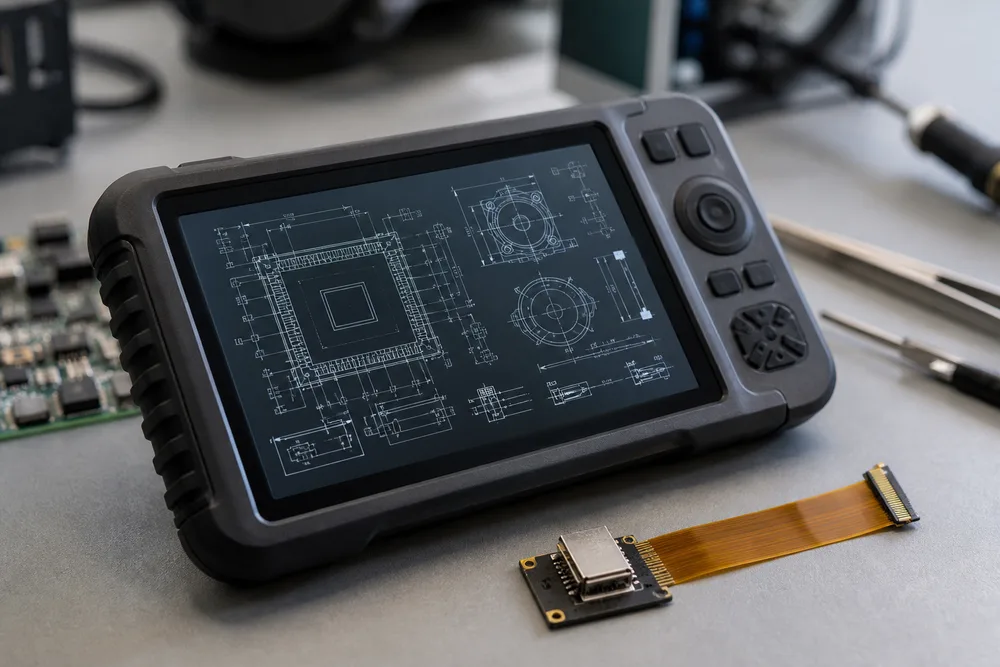
Key Takeaways: HJ3170-01FPC-A1 Display Compatibility at a Glance
- HJ3170-01FPC-A1 is a 3.17-inch IPS TFT LCD module with 1024(RGB)×768 resolution.
- The display uses a MIPI interface, a 30-pin connection and a JD9168 driver IC.
- A six-pin capacitive-touch interface is present on the cable; confirm the supplied touch stack with the product documentation and quotation.
- Host MIPI support, connector pinout, FPC routing and mechanical stack-up must be checked before sampling.
- HONGJIA supports small orders, longer-term supply discussions and custom display projects.
The HONGJIA HJ3170-01FPC-A1 is not a generic drop-in screen simply because its diagonal matches an existing 3.17-inch Liquid Crystal Display. Its 1024(RGB)×768 pixel format, MIPI display interface, 30-pin FPC and JD9168 controller define the real integration boundary. Those details decide whether your processor board can initialise the panel, whether the flex reaches without folding stress, and whether your enclosure clears the active viewing area.
IPS is relevant here because it is intended for consistent viewing across off-axis positions, a practical advantage on handheld terminals, instruments and compact control panels that are rarely viewed dead-on. It does not remove the need to assess backlight behavior, cover-lens treatment or optical bonding for your use case. Start with the HJ3170-01FPC-A1 3.17-inch IPS TFT LCD, then verify the electrical and mechanical documents against your own assembly.
HJ3170-01FPC-A1 Specifications and How It Differs from Other 3.17-Inch LCD Modules
Diagonal size is the least useful way to compare compact display modules. Two 3.17-inch parts can differ in pixel arrangement, interface timing, flex exit direction, driver IC and touch provision. A replacement selected from a size filter may fit the front bezel yet fail at the board connector or never complete panel initialisation. The HJ3170-01FPC-A1 is specified as a TFT Liquid Crystal Display module using IPS technology, with a 1024(RGB)×768 resolution and white LED backlight.
That resolution is materially different from lower-resolution small displays often used in cost-sensitive products. It can suit interfaces with dense text, detailed icons or diagnostic information, but it also places a different burden on the host display subsystem. Confirm supported pixel format, lane configuration, timing settings and JD9168 initialisation requirements from the current datasheet rather than borrowing a sequence from another MIPI panel.
| Selection point | HJ3170-01FPC-A1 | Why buyers should check it |
|---|---|---|
| Display type | 3.17-inch IPS TFT LCD | Viewing characteristics and optical behavior are not defined by diagonal size alone. |
| Resolution | 1024(RGB)×768 | Host graphics, timing and user-interface assets must match the panel format. |
| Display interface | MIPI | MIPI physical connection does not guarantee compatible software or timing. |
| Main FPC | 30 pins | Pin count alone is insufficient; match pinout, connector type and flex orientation. |
| Driver IC and backlight | JD9168; white LED | These affect firmware setup and the design of the backlight power and dimming circuit. |
For the authoritative product reference, review the 3.17-inch 1024×768 MIPI LCD module listing before locking a substitute into your bill of materials.
MIPI Display Integration Checklist: Verify Host, FPC, Touch and Mechanical Fit Before Sampling
The costly failure is usually discovered after a sample has been mounted in a machined enclosure: the image works, but the flex exits into a rib, the connector sits on the wrong board side, or touch has no controller path. Treat a sample as an engineering check, not a visual demonstration. MIPI display integration also requires the host processor and operating system or firmware to support the necessary panel configuration.
- Confirm the host path. Check that the processor exposes a suitable MIPI display interface and that your software team can apply the required JD9168 panel initialisation and timing data.
- Match the 30-pin FPC. Obtain the pin assignment, connector specification, flex orientation and permitted bend area. Do not infer any of them from pin count.
- Review touch separately. The cable has a six-pin capacitive-touch interface. Identify the touch controller arrangement, connector path and firmware ownership before committing to a front-glass design.
- Check the mechanical drawing. Compare module outline, viewing area, active area, thickness, mounting approach and FPC exit with the enclosure and PCB in CAD.
- Run a system sample. Test cold start, backlight control, image stability, touch behavior where applicable, and cable retention in the assembled product.
Ask for the latest datasheet and drawing for the exact revision you are evaluating. A display family name is not enough for release control.
From Sample Evaluation to Production: HONGJIA Custom Display and Supply Support
Display sourcing goes wrong when the purchasing team approves a screen from a photograph while engineering is still working from an old pinout. HONGJIA’s stated range covers small and medium TFT LCD modules, touch LCDs, CTP touch screens, OLED, long-strip, transflective and wide-temperature displays for applications including instrumentation, medical equipment, industrial control, POS and handheld devices. That breadth is useful only if the supplier understands which requirement cannot move: interface, optical stack, temperature expectation, bezel geometry or availability plan.
HONGJIA FAE support refers to field-application engineering assistance around the display integration work itself: reviewing the interface and FPC information, helping clarify a module’s driver and touch connections, and supporting issue resolution during sampling or production preparation. It is not a substitute for your electrical validation. Your team still owns host-board design, firmware and finished-product qualification. Used early, though, FAE involvement can expose a connector mismatch before tooling, rather than after it.
For custom display work, give HONGJIA the target application, interface, dimensional constraints, touch requirement, intended operating conditions and annual demand outlook. The company states that it supports small orders and long-term supply discussions, and lists ISO9001, ISO14001, ISO45001 and ISO13485 certifications. Request documentation relevant to your quality process rather than treating a certificate list as automatic approval for a regulated finished product.
3.17-Inch 1024×768 MIPI LCD FAQ
Is the HJ3170-01FPC-A1 compatible with every MIPI host platform?
No. MIPI identifies an interface family, not universal plug-and-play compatibility. Your host must provide the appropriate display hardware, and its firmware must support the panel’s required timing and JD9168 initialisation sequence. The 30-pin FPC must also match your connector, pinout and board layout. Request the current datasheet before building an adapter board or modifying a carrier board around this module.
Does this 3.17-inch LCD module include a touch screen?
The supplied product information states that a six-pin capacitive-touch interface is present on the cable. That confirms a touch connection is part of the module arrangement, but it does not by itself define the exact touch-panel construction, cover glass, controller arrangement or what is included in a particular order. Confirm the touch configuration, controller support and supplied assembly in the quotation and approved datasheet. This matters especially where your enclosure needs a specific cover-lens shape or printing border.
A high-resolution compact LCD should be selected around the whole system: panel, touch path, processor, FPC and enclosure. The HONGJIA 3.17-inch TFT display page is the right starting point for the current product reference.
Request a Sample, Datasheet or Production Enquiry for the HONGJIA 3.17-Inch TFT LCD
Send the exact HJ3170-01FPC-A1 reference with your request, then attach the information that lets an engineer give a useful answer: host processor or display-interface details, target application, PCB connector preference, mechanical drawing, touch requirement and projected production timing. If this is a replacement display, include photographs of the original FPC and connector plus the existing panel label. Those are often more revealing than a diagonal measurement.
For a production enquiry, ask for the current revision-controlled datasheet, dimensional drawing, pin definition and sample terms. If your program has a custom cover lens, unusual mechanical clearance or a controlled supply requirement, state that before the sample is issued. It keeps the evaluation focused on the module you can actually build into the product.
Discuss the HJ3170-01FPC-A1 with HONGJIA
Use the official product page to request current module information for your sample build, replacement project or production program.
Visit Official Website →