English
 Español
 Português
 русский
 Français
 日本語
日本語 Deutsch
 tiếng Việt
 Italiano
 Nederlands
 ภาษาไทย
 Polski
 한국어
한국어 Svenska
 magyar
 Malay
Malay বাংলা ভাষার
 Dansk
Dansk Suomi
Suomi हिन्दी
Choose the manufacturer that can prove a fit with your device, support the design decisions that affect integration, and supply the display through your product life—not simply the one that offers the lowest panel price. A cheap quotation can become expensive after a mismatched interface, unreadable outdoor screen, touch issue, or late component change forces a board or enclosure revision.
For international OEM buyers, a China Liquid Crystal Display supplier should be assessed in the same order your product is developed: device requirements first, product fit second, engineering and documentation next, then supply risk. Price belongs in that discussion, but it should not lead it.
Start with Device Requirements Rather Than the Lowest Display Price
A useful request for quotation describes the finished device, not just a diagonal size. The display is tied to the enclosure opening, the main board, the user’s viewing position, the touch method, and the environment. If those inputs are vague, suppliers will quote different constructions and the price comparison will mean very little.
Define the required display format, size range, viewing conditions, and operating environment
State whether the device needs a square, round, rectangular, or bar-type screen; the usable viewing area; portrait or landscape orientation; and where it will be read. A display for an industrial instrument inside a cabinet faces different demands from an LCD display for a POS terminal near a window. Ambient light, expected viewing angle, protective cover glass, moisture exposure, vibration, and temperature conditions all affect the right module choice.
HONGJIA’s stated range covers small and medium displays from 1.14 inches to 15 inches, including square, round, IPS, long-strip, touch, and transflective formats. That breadth is useful only if you narrow the application first. Do not ask for “the best screen.” Ask for the format that lets your user read the right information in the actual installation.
Confirm interface, touch, mechanical, and host-system requirements before requesting quotations
Confirm the display interface your host board can support, the connector position and cable routing, mounting points, module thickness, bezel clearance, and required touch construction. For touch LCD display modules, the controller, cover lens, bonding method, and firmware responsibilities must be clear. A touch panel may fit the front housing but still create an integration problem if its controller is not accounted for on the host system.
Send a controlled drawing package where possible. Include the enclosure constraint, board layout restrictions, intended mounting method, and the revision level of your design. That gives a supplier something concrete to review instead of a list of assumptions.
Assess Whether the Manufacturer’s Product Range Fits Your Design
Look for range relevance, not a catalogue with the most entries. A manufacturer should have display types that match your product category and be able to explain the trade-offs between them.
Compare TFT LCD modules, IPS screens, round and square displays, touch LCDs, and long-strip formats
TFT LCD modules suit many graphical interfaces, but the panel format still drives the mechanical design and user experience. A round display can make sense for a gauge-style interface or compact control dial; a square module may suit a thermostat or instrument; a long-strip LCD is often considered where the available front-panel space is narrow and wide. IPS screens are commonly selected where viewing angle and image consistency matter, but they are not a substitute for defining the lighting conditions around the device.
For a small or medium product, review the manufacturer’s actual category coverage rather than forcing a standard module into an awkward housing. You can review HONGJIA’s LCD display range for the formats it identifies, including TFT modules, OLED displays, bar-type displays, and in-cell touch displays.
Determine when a transflective LCD module or CTP touch screen is appropriate
A transflective LCD module is worth discussing for a device that must remain readable in strong ambient light, especially where the installed location cannot control glare. It is not an automatic upgrade for every outdoor product; confirm the full optical stack, cover treatment, backlight behaviour, and the user’s viewing direction before selecting it.
A CTP capacitive touch screen is appropriate when the interface calls for finger-operated gestures or a clean front surface. Check glove use, water exposure, false-touch risk, cover thickness, and electrical noise in the finished device. Buyers sometimes select touch based on a phone-like experience, then discover that the real operator wears gloves or works beside wet equipment.
Evaluate Custom LCD Module Capability and FAE Support Early
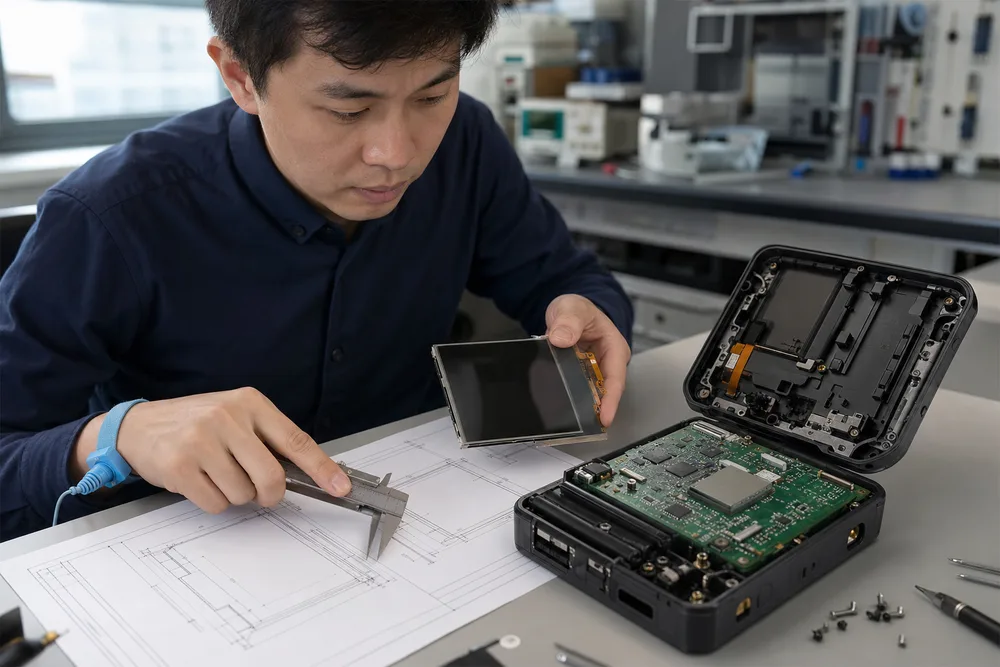
Custom work should begin with an engineering conversation, not an artwork change request. Ask what can be reviewed at module level: dimensions, interface arrangement, touch integration, cover glass, display format, and application constraints. Then ask which items require validation on your side before a design can be released.
HONGJIA states that it offers custom solutions and FAE technical support. For an OEM, the practical test is how that support is used. Can the team review your host-system requirements before you commit to a module? Will it identify a connector-access conflict or interface mismatch before samples are built? Can it clarify the document revision controlling the sample? Those answers matter more than a broad promise of customization.
Keep technical decisions in writing. A custom LCD module project can drift when the drawing, touch arrangement, cable direction, and sample approval notes live in separate email threads. One agreed specification package reduces that risk.
Request Quality, Compliance, and Documentation Evidence Relevant to Your Product
Request evidence that applies to the exact module and your destination market. The right package may include the current mechanical drawing, electrical specifications, interface information, touch-controller details where relevant, inspection criteria, packaging method, traceability approach, and declarations or test evidence needed for your product’s compliance route. Do not assume a document for one display construction covers another.
Ask how drawing revisions are issued, how a supplier records approved samples, and what happens if a material or component needs to change. These are ordinary questions, yet they expose costly gaps. A module can appear identical while a connector, backlight assembly, polarizer treatment, or touch construction has changed enough to affect your production build.
Medical equipment, automotive electronic instruments, industrial controls, and consumer products each carry different documentation expectations. Give the supplier the application context early, then have your own quality and regulatory teams decide what evidence is required. A display manufacturer should support that review; it should not make unsupported compliance claims on your behalf.
Identify Supply Risks Before Selecting a China TFT LCD Display Manufacturer
Supply risk is not limited to lead time. Review minimum order expectations, sample availability, forecast handling, revision control, packaging for your shipping route, communication during component changes, and the supplier’s approach to long-term availability. HONGJIA states that it supports small-quantity orders and long-term supply, but your programme still needs written confirmation against the specific display selected.
Watch for four common warning signs:
- A quotation lists a display description but no controlled drawing or revision.
- The supplier cannot explain the difference between the quoted module and the approved sample.
- Interface and touch details are deferred until after price approval.
- Your team has no named route for technical questions during prototype and production stages.
These issues usually surface as assembly delays, unexpected board changes, rejected incoming parts, or a screen that performs differently once installed. A lower initial quote rarely offsets a late enclosure-tool or PCB revision.
Use a Practical Shortlist Checklist for Liquid Crystal Display Suppliers
Shortlist a Liquid Crystal Display manufacturer only after it can answer the following points clearly:
- Does its standard product range fit the required size, format, viewing condition, and application?
- Has it reviewed the interface, mechanical envelope, touch need, and host-system constraints?
- Can it support the custom elements your device genuinely needs?
- Can its FAE team work from controlled drawings and respond during integration?
- Will it provide documentation and revision information relevant to your quality and compliance process?
- Are sample, order quantity, supply continuity, and change-notification expectations understood in writing?
If your shortlist needs a technical review rather than another generic catalogue, start with HONGJIA’s custom LCD module and FAE support and provide your device requirements, drawing constraints, and intended application.