 English
 Español
 Português
 русский
 Français
 日本語
日本語 Deutsch
 tiếng Việt
 Italiano
 Nederlands
 ภาษาไทย
 Polski
 한국어
한국어 Svenska
 magyar
 Malay
Malay বাংলা ভাষার
 Dansk
Dansk Suomi
Suomi हिन्दी
2026 Ultimate Guide to the 3.17 Inch Horizontal LCD Screen 1024*768 RGB 16/18/24BIT for US Manufacturers
Key Takeaways & Executive Summary
- Extreme Pixel Density: Delivers an incredible 1024*768 resolution in a compact 3.17-inch landscape form factor, achieving over 400 PPI for medical-grade and high-precision industrial monitors.
- Broad Protocol Interfacing: Native support for 16-bit, 18-bit, and 24-bit RGB inputs via a standardized 40-pin FPC connector, making it highly versatile for legacy and next-gen ARM/MCU platforms.
- Direct Sunlight Readability: Backlight brightness configurable from 500 to 1000 nits (lumens), ensuring clear outdoor visibility in North American deployment zones.
- US Compliance Standards: Full adherence to RoHS, CE, FCC, and UL regulations, ideal for critical medical endoscopes and heavy-duty smart-grid equipment.
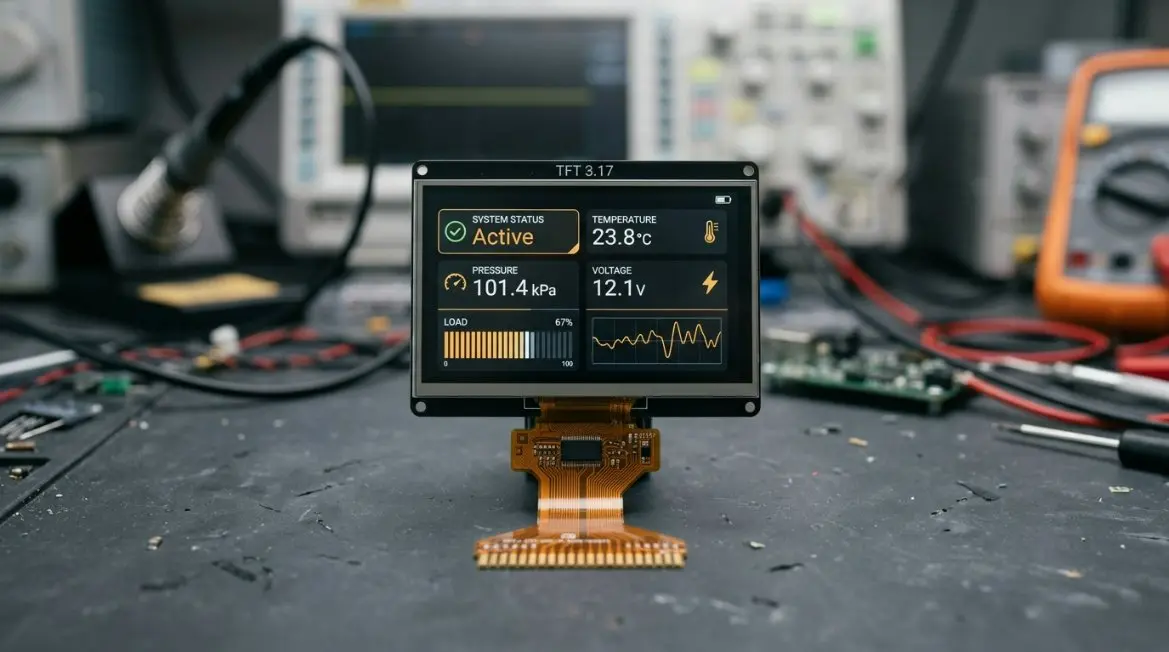
Key Takeaways: Why the 3.17 Inch 1024x768 RGB LCD Dominates the 2026 US IoT Market
The US hardware and IoT sectors are undergoing a massive shift towards compact, high-definition visualization. For years, design engineers were forced to compromise between ultra-compact footprint sizes and high graphical fidelity. The introduction of our high-reliability 3.17 Inch Horizontal LCD Screen 1024*768 RGB 16/18/24BIT solves this bottleneck. Sporting a pixel density that mirrors high-end smart-phone panels, this ultra-sharp landscape screen is purpose-built to deliver crystal-clear diagnostics, rich modern user interfaces, and instantaneous refresh times.
US manufacturers in sectors such as non-destructive testing (NDT), surgical medical endoscopes, and handheld tactical gear demand ruggedized configurations that can operate reliably in varying environments. Thanks to a configurable LED backlight reaching up to 1000 nits, this display maintains perfect readability in dark clinical rooms as well as under direct high-noon sunlight. Its symmetrical left and right bezels facilitate seamless mechanical alignment within specialized enclosures.
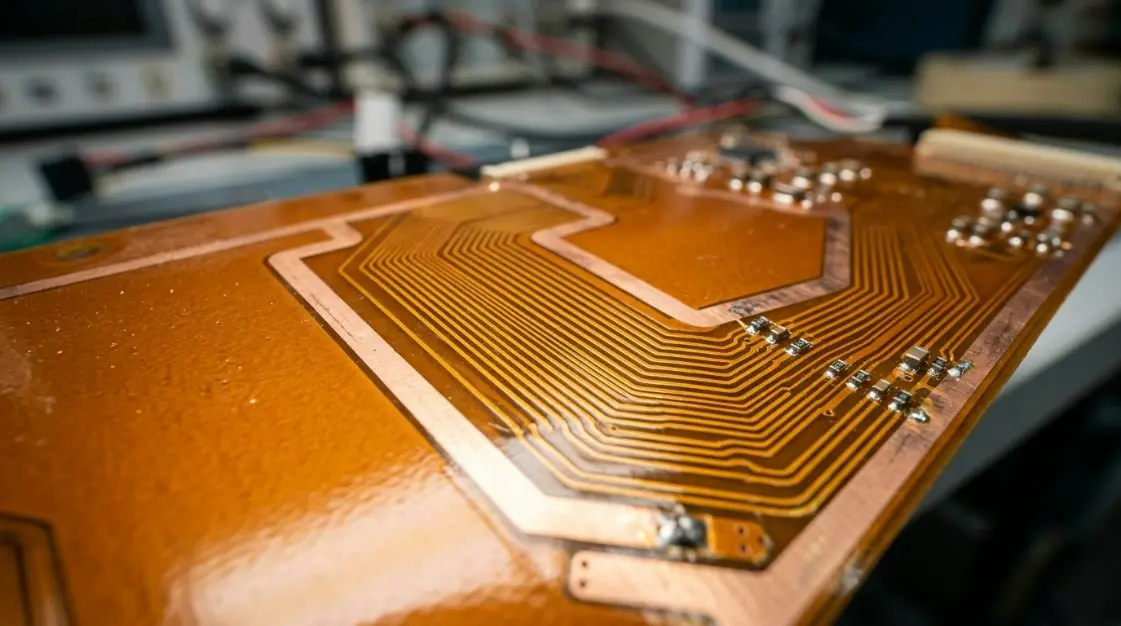
Core Innovation: The ChromaSync™ Precision Protocol for 3.17 Inch Horizontal LCD Screen 1024*768 RGB 16/18/24BIT
At the center of this display module's performance is our proprietary ChromaSync™ Precision Protocol. High-resolution screens integrated within compact enclosures are notoriously vulnerable to Electro-Magnetic Interference (EMI) and signal attenuation across the FPC. The ChromaSync™ Precision Protocol actively stabilizes signal transition timings between the 16/18/24-bit lines and the internal driver controller. By dynamically balancing phase margins and optimizing clock distribution, this technology ensures zero frame-skipping and prevents display flicker even when subjected to adjacent high-frequency RF components.
For US medical device manufacturers, this protocol ensures absolute image fidelity. Real-time surgical cameras and endoscopic instruments can display microscopic anatomical structures with zero color deviation or trace delays, aligning precisely with rigorous FDA-approved diagnostic demands.
Exclusive Access: Downloadable 2026-Standard 3D CAD Models & US Market Transparent Lead Times
We believe in accelerating your Time-to-Market. To assist your mechanical engineering team, we offer fully validated STEP/IGES 3D CAD files matching the 2026 revision standards. Our supply chain features transparent lead times tailored for American domestic buyers: initial prototyping samples ship out within 5-7 business days, while volume production orders are supported by our rolling US-warehoused safety stock to shield your production lines from global transit bottlenecks.
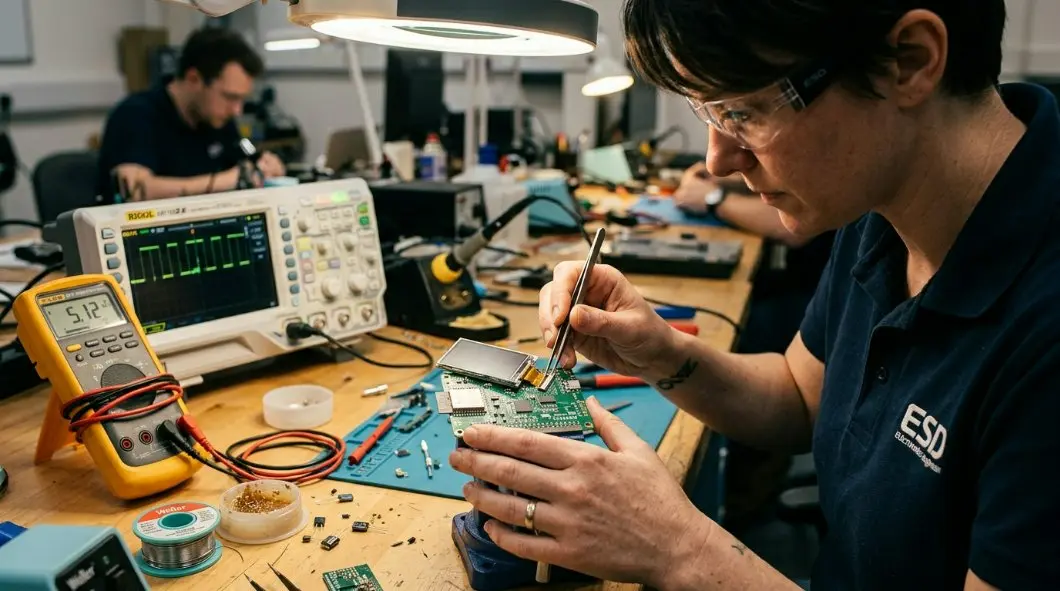
Step-by-Step Tutorial: Native Integration Guide for the Latest AI-Driven IoT Microcontrollers
Integrating a high-density RGB screen into dynamic modern hardware environments requires accurate physical and logical initialization. Follow this validated engineering blueprint to interface your display.
Step 1: Preparing the 16/18/24BIT RGB Interface and FPC Connectors
Begin by verifying your host board features a compatible 40-pin FPC connector with a 0.5mm pitch. Route the power lanes (VDD and VDD_IO) as close to the voltage regulator as possible to minimize loop inductance. For the RGB interface, designate the matching signal lines depending on your target color depth. For maximum performance (16.7 million colors), trace all 24 data lines (R0-R7, G0-G7, B0-B7) ensuring length matching on all high-speed parallel buses.
Step 2: Syncing the Data Enable (DE) and Dot Clock (DCLK) Signals
To avoid screen shifting, ensure your MCU's LCD controller is set to DE (Data Enable) Mode. Route the DCLK (Dot Clock) with an adjacent ground plane to isolate high-frequency harmonics. Set your line scan timings within the controller register to prevent visual artifacts. Signal integrity can be further protected by placing 22-ohm series resistors on the DCLK, HSYNC, and VSYNC lines near the driver IC.
Step 3: Initializing Display Drivers for Optimal 1024*768 Resolution
Configure the system registers of your graphics driver (such as a modern ST or Renesas display bridge) to set the active horizontal width to 1024 pixels and the vertical height to 768 pixels. Apply the specific frame rate parameters—ideally 60Hz—to avoid display flicker. Below is a sample pseudocode initialization sequence:
// LCD Driver Timing Initialization Matrix
LCD_Write_Reg(0x01); // Software Reset
Delay_ms(120);
LCD_Write_Reg(0xB0, 0x00); // Set RGB Mode
LCD_Write_Reg(0xC0, 0x04); // Set Landscape/Horizontal scan
LCD_Write_Reg(0xD0, 0x01); // Enable ChromaSync Precision Protocol
LCD_Write_Reg(0xE0, 0x03); // Configure 1024x768 Horizontal/Vertical active timings
LCD_Write_Reg(0x29); // Display ON
Step 4: Waterproofing and Resealing the Bezel for IP67/IP68 Industrial Applications
For deployment in harsh marine, outdoor IoT, or medical sterilizing environments, mount the 3.17-inch screen with a customized die-cut gasket. Utilize high-performance closed-cell polyurethane foam or optical clear adhesives (OCA) to bond a protective cover glass over the symmetrical bezels. Ensure a compressed fitment of 30-40% of the gasket thickness to form a certified dust- and water-tight barrier meeting IP67 or IP68 specifications.
Specification Guide & Technical Comparison Matrix: 16-bit vs. 18-bit vs. 24-bit RGB
Choosing the correct color interface depends on your system resources, power budget, and graphical requirements. While 24-bit RGB offers maximum visual fidelity, 16-bit minimizes the controller's pin-count and memory footprint.
Evaluating Color Depth, Bandwidth Requirements, and Display Fidelity
The table below outlines the distinct engineering tradeoffs for the premium 3.17-inch landscape LCD display across its primary operating modes:
| Specification Parameter | 16-Bit RGB Mode | 18-Bit RGB Mode | 24-Bit RGB Mode (Full Precision) |
|---|---|---|---|
| Total Color Count | 65,536 (65K) Colors | 262,144 (262K) Colors | 16,777,216 (16.7M) Colors |
| Active Data Lines | 16 Pins (R:5, G:6, B:5) | 18 Pins (R:6, G:6, B:6) | 24 Pins (R:8, G:8, B:8) |
| Required Bandwidth (at 60fps) | ~755 Mbps | ~850 Mbps | ~1.13 Gbps |
| Typical Use Case | Battery-powered handhelds, low-power IoT | Retro game consoles, standard HMI | Medical diagnostics, surgical endoscopes |
Mathematical & Electrical Calculation Guidance: Power Supply Load Formulas
Proper electrical design prevents premature aging of the LED backlighting and guarantees clean, noise-free logic levels across your system board.
Calculating Exact Wattage, Backlight Current (mA), and Pixel Clock Frequency
To design an efficient buck regulator and thermal management system, utilize the following engineering formulas:
1. Total Power Consumption (P_total) Formula:
   P_total = P_logic + P_backlight
   P_logic = VDD * IDD = 3.3V * 15mA = 49.5 mW
   P_backlight = V_led * I_led

   *For standard 500 nits backlight configuration:
   P_backlight = 9.6V * 40mA = 384 mW
   P_total = 49.5 mW + 384 mW = 433.5 mW

2. Pixel Clock Frequency (F_clk) Calculation:
   F_clk = H_total * V_total * Frame_Rate
   Where:
     H_total = Active Horizontal (1024) + Blanking (H_Front_Porch + H_Back_Porch + H_Sync_Width)
     V_total = Active Vertical (768) + Blanking (V_Front_Porch + V_Back_Porch + V_Sync_Width)

   *Assuming standard parameters:
   H_total = 1024 + 160 = 1184
   V_total = 768 + 38 = 806
   Frame_Rate = 60 Hz
   F_clk = 1184 * 806 * 60 = 57,258,240 Hz = ~57.26 MHz
US Regional Standards & Certifications: Ensuring UL, CE, RoHS, and FCC Compliance
Entering the US market requires strict compliance with safety and environmental laws. Our 3.17 Inch Horizontal LCD modules are fully certified to meet the regulatory frameworks demanded by major American buyers and federal authorities:
- RoHS & REACH Compliance: Completely free from lead, mercury, hexavalent chromium, and polybrominated biphenyls, aligning with state-specific regulations like California Proposition 65.
- FCC Part 15 Class B: Tested under extreme conditions to guarantee minimal electromagnetic radiation, making it secure for medical spaces and residential smart home deployments.
- UL 62368-1 Readiness: Backed by high-grade component materials that resist fire and mechanical degradation, aiding in seamless end-product safety approvals.
Frequently Asked Questions (FAQ): 3.17 Inch LCD Screen Voice Search & PAA
Is this 3.17 Inch Horizontal LCD compatible with Smart Home Ecosystems like Matter standard, Apple HomeKit, and Amazon Alexa?
Yes. Although this display utilizes raw 16/18/24-bit RGB signaling at the hardware level, it easily connects to processors running Linux, RTOS, or high-end microcontrollers (like ESP32-S3 or STM32 series) which act as the smart home hubs. By deploying an appropriate GUI framework (like LVGL or Qt), you can design stunning control panels that interface with Matter, HomeKit, or Alexa via Wi-Fi/Thread.
What are the exact mechanical cutting tolerances and bezel spacing for custom US manufacturing?
The physical outer glass features a precision cutting tolerance of +/- 0.15mm. The left and right bezels are mathematically symmetrical at 1.8mm each, simplifying structural integration. We recommend maintaining a mechanical gap of 0.3mm around the display's perimeter to absorb external physical shocks and avoid screen bruising under extreme structural pressure.
What are the essential safety instructions and voltage limits to prevent backlight burnout?
The backlight driver must be driven with a constant current source, never a constant voltage source. Limit the maximum forward current (I_led) to 45mA to avoid thermal runaway. Exceeding 10.2V on the backlight array without current limiting will cause immediate thermal stress and permanently burn out the LED array, reducing the device's operational lifespan.
Ready to Upgrade? Request a Quote and Technical Docs for Your Next Project
Visit https://www.lcdtftlcd.com/3-17-inch-horizontal-lcd-screen-1024-768-rgb-16-18-24bit.html to Secure US Inventory and Support
Ensure your hardware stands out in the highly competitive US market. Incorporate our state-of-the-art display to maximize clarity, system efficiency, and overall reliability. Take advantage of our direct support channels and secure pre-negotiated volume pricing today.
Looking for Custom Engineering/OEM Solutions?
As a top-tier professional manufacturer, we deliver direct factory-price solutions for dynamic scaling, engineering projects, and custom systems globally.
Visit Official Website →Send Inquiry


X
We use cookies to offer you a better browsing experience, analyze site traffic and personalize content. By using this site, you agree to our use of cookies.
Privacy Policy