 English
 Español
 Português
 русский
 Français
 日本語
日本語 Deutsch
 tiếng Việt
 Italiano
 Nederlands
 ภาษาไทย
 Polski
 한국어
한국어 Svenska
 magyar
 Malay
Malay বাংলা ভাষার
 Dansk
Dansk Suomi
Suomi हिन्दी
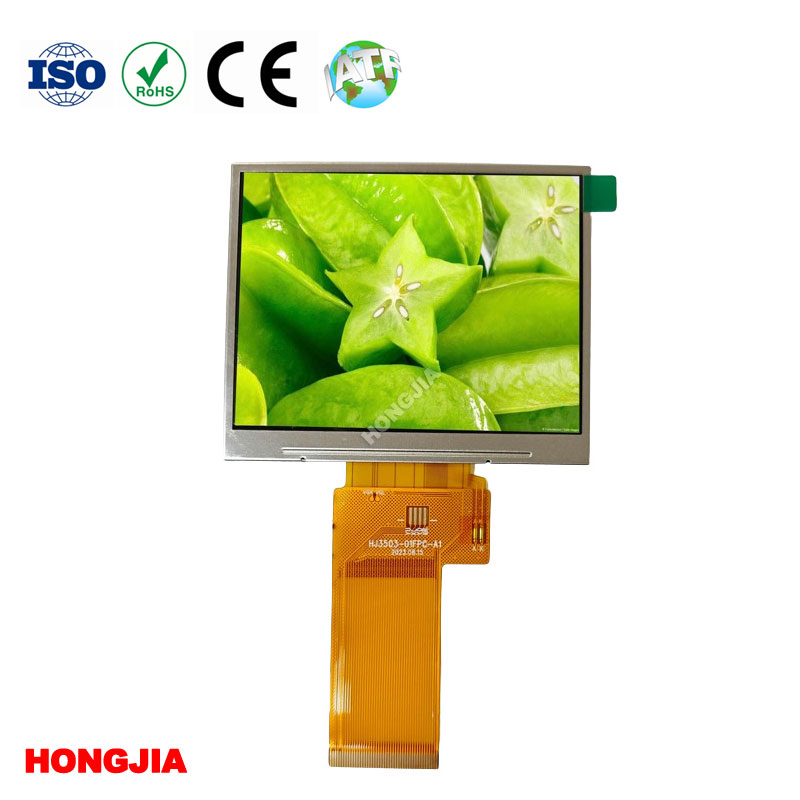
3.5-Inch Horizontal Screen: 320x240 TFT LCD with MCU Interface
HONGJIA’s HJ3503-01 is a 3.5-inch landscape IPS TFT LCD with 320 × 240 resolution, an ST7796 driver IC, and a standard 45-pin plug connection. Its defining design advantage is interface choice: the module can be configured for SPI, MCU, or RGB communication, giving you options for hosts ranging from compact microcontrollers to processors with a dedicated display output.
The HJ3503-01 3.5-inch landscape TFT LCD is aimed at embedded products that need a native horizontal QVGA display rather than a portrait panel rotated mechanically or in software. Before committing a PCB, confirm which interface implementation, pinout, backlight, and optional touch configuration applies to your quotation.
A Landscape QVGA Display for Hosts That Need SPI, MCU, or RGB Flexibility
A native 320 × 240 landscape layout fits interfaces built around menus, graphs, status fields, soft keys, and side-by-side readings. That makes the format practical for industrial controls, instrumentation, handheld equipment, appliance panels, POS devices, and smart-home controllers.
The interface choice is more significant than the diagonal size. SPI can reduce host pin use, while an MCU-style parallel bus can support more frequent screen updates when the host has enough GPIO. RGB is generally the better fit when the processor already provides a display engine and continuous pixel timing. These aren’t interchangeable wiring choices: each can require a different FPC assignment, controller setup, and host-side design.
The ST7796 driver is another useful reference point for firmware planning. Your software team still needs the initialization sequence for the exact module configuration; a generic ST7796 example may not match its panel timing, orientation, color order, or power settings.
Confirmed HJ3503-01 Specifications and Details That Depend on Configuration
Confirmed module facts: 3.5-inch transmissive IPS, 320×240 pixels, ST7796, 45-pin connection, 70.08 × 52.56 mm active area, and 76.9 × 64 × 3.26 mm outline
| Parameter | Confirmed specification |
|---|---|
| Display size | 3.5 inches |
| Display type | Transmissive IPS TFT LCD |
| Native resolution | 320 × 240 pixels, QVGA |
| Orientation | Landscape / horizontal |
| Driver IC | ST7796 |
| Connection | 45-pin plug |
| Interface options | SPI, MCU, or RGB |
| Active area | 70.08 × 52.56 mm |
| Module outline | 76.9 × 64 × 3.26 mm |
The active area is the visible pixel region, not the complete opening or mounting envelope. Mechanical drawings should control bezel design, connector clearance, FPC routing, and tolerance stack-up. Designing from the nominal outline alone is a common way to end up with a housing that covers pixels or loads the glass edge.
Confirm brightness, viewing direction, operating temperature, touch, backlight, FPC, and interface implementation for the quoted version
Brightness is not confirmed in the supplied specification, so this page does not label the module as a 500-nit or sunlight-readable display. Ask for the measured luminance and its test conditions. A transmissive LCD also depends on its backlight for visibility; LED arrangement, current requirements, connector pins, lifetime criteria, and dimming method belong in the electrical review.
IPS identifies the panel technology, but it doesn’t replace numeric viewing-angle data or an approved sample. Confirm the viewing direction and inspect the display in the intended enclosure, especially if operators will see it from below or off-axis.
Operating and storage temperature limits, touch support, cover lens details, FPC geometry, and backlight construction can vary by configuration. HONGJIA offers touch screen, FPC, backlight, interface, wide-temperature, and sunlight-readable customization across its display range, but those features shouldn’t be assumed to be standard on every HJ3503-01 quotation.
Choose the Interface Around Host Architecture, Update Rate, and Available Pins
When SPI, MCU, and RGB interfaces suit different embedded display designs
SPI is a sensible starting point for pin-limited microcontrollers and screens dominated by static text, icons, and occasional value changes. The trade-off is transfer time. Full-screen animation or rapid graph updates may expose bandwidth limits, depending on clock rate, protocol overhead, and firmware strategy.
MCU interface suits controllers with enough pins for a parallel display bus. It can shorten transfer time compared with a serial connection, but it consumes more GPIO and complicates PCB routing. Confirm bus width and control signals rather than assuming that “MCU” means one universal pin arrangement.
RGB interface is appropriate when the host processor has a compatible LCD controller and can generate the required pixel clock and synchronization signals. It can support fluid updates, but it places more responsibility on the host’s display engine, memory architecture, and timing configuration.
Verify the 45-pin pinout, connector orientation, signal levels, bandwidth, and ST7796 initialization before PCB release
A 45-pin count does not make two displays electrically compatible. Check every pin against the released module drawing, including power rails, grounds, backlight connections, reset, chip select, data or RGB lines, and unused pins. Connector contact direction and FPC insertion orientation matter too; a mirrored footprint can turn a routine prototype into a board re-spin.
Confirm logic-voltage requirements and whether level shifting is needed. Then test the intended screen-update behavior on real hardware. For the 3.5-inch TFT LCD with MCU interface, request the matching ST7796 initialization code instead of relying solely on a controller vendor’s generic register list.
Where This 3.5-Inch Landscape TFT Fits—and Where Requirements May Call for Another Configuration
The module fits compact industrial-control panels where 320 × 240 pixels are enough for machine states, setpoints, trend fragments, and maintenance menus. Instrumentation can use the horizontal active area for a primary reading beside secondary data. Handheld terminals, appliance controls, communications equipment, and small POS interfaces are other plausible applications.
Resolution is the first limitation to accept. QVGA works well for purpose-built embedded interfaces, but it isn’t ideal for dense documents, detailed imaging, or desktop-style application screens. SPI may also be a poor fit for animation-heavy graphics unless the design uses partial updates carefully.
Outdoor equipment may need a confirmed high-brightness or sunlight-readable configuration. Vehicle installations need verified temperature, vibration, lifetime, and qualification data. Medical-equipment use requires the product manufacturer to validate all applicable safety, quality, and regulatory requirements; the display format alone doesn’t establish medical compliance.
Use Verifiable Design-In Files to Move from Evaluation to Production
Request the downloadable datasheet, dimension and active-area drawings, pinout, initialization resources, sample terms, MOQ, lead time, lifecycle plan, customization options, quality documents, and warranty details
Move through the design-in process in this order:
- Identify the host processor and select SPI, MCU, or RGB based on available pins, required update behavior, and display-controller support.
- Obtain the version-controlled datasheet, mechanical drawing, 45-pin assignment, connector orientation, electrical limits, backlight specification, and ST7796 initialization resources.
- Request samples and evaluate color, viewing position, brightness, startup behavior, update rate, thermal performance, and mechanical fit in the real enclosure.
- Before production approval, confirm MOQ, sample terms, lead time, change-notification practice, lifecycle plan, customization scope, quality documents, warranty terms, and the exact revision that will ship.
Send HONGJIA your host platform, preferred interface, target brightness, operating-temperature range, touch requirement, annual quantity, and mechanical constraints when you request the HJ3503-01 datasheet, sample, and quotation.
Send Inquiry


X
We use cookies to offer you a better browsing experience, analyze site traffic and personalize content. By using this site, you agree to our use of cookies.
Privacy Policy