 English
 Español
 Português
 русский
 Français
 日本語
日本語 Deutsch
 tiếng Việt
 Italiano
 Nederlands
 ภาษาไทย
 Polski
 한국어
한국어 Svenska
 magyar
 Malay
Malay বাংলা ভাষার
 Dansk
Dansk Suomi
Suomi हिन्दी
Differences Between 2.4-inch AMOLED and TFT Displays Regarding Power Consumption, Brightness, and Color Gamut
Many clients frequently ask about the differences between 2.4-inch AMOLED screens and 2.4-inch TFT screens. Today, the engineering team at Shenzhen Hongjia Technology will outline the distinctions between the two. The fundamental difference between AMOLED and TFT (typically referring to TFT-LCD) lies in their light-emitting principles: AMOLED pixels are self-illuminating, whereas TFT relies on a global backlight panel for illumination. This distinction directly results in differing performance characteristics regarding power consumption and brightness:
1. Power Consumption Performance
AMOLED is more power-efficient(especially in dark scenes): When displaying black, individual pixels are completely turned off (consuming 0 power); when displaying dark colors or static images, energy consumption is extremely low, making it ideal for "always-on" watch faces and nighttime use.
TFT power consumption is relatively fixed: Regardless of the content being displayed, the backlight panel remains essentially fully active. Power savings are only marginal when the screen is entirely white and the backlight brightness is reduced; while overall energy consumption fluctuations are minimal, the baseline power draw remains higher.
2. Brightness Performance
AMOLED offers higher peak brightness and superior clarity: For small-format 2.4-inch AMOLED displays, the local peak brightness can often exceed 1000 nits. This ensures the image remains clear and sharp even under bright outdoor lighting, with transparent colors free from any "washed-out" or hazy layers.
TFT is limited by its backlight: For a TFT display of the same size, the typical full-screen brightness usually falls between 300 and 500 nits, making it difficult to view clearly under strong lighting conditions. While high-brightness models can be produced by increasing the number of backlight LEDs, this results in a drastic surge in power consumption and increased heat generation.
3. Contrast Ratio Differences
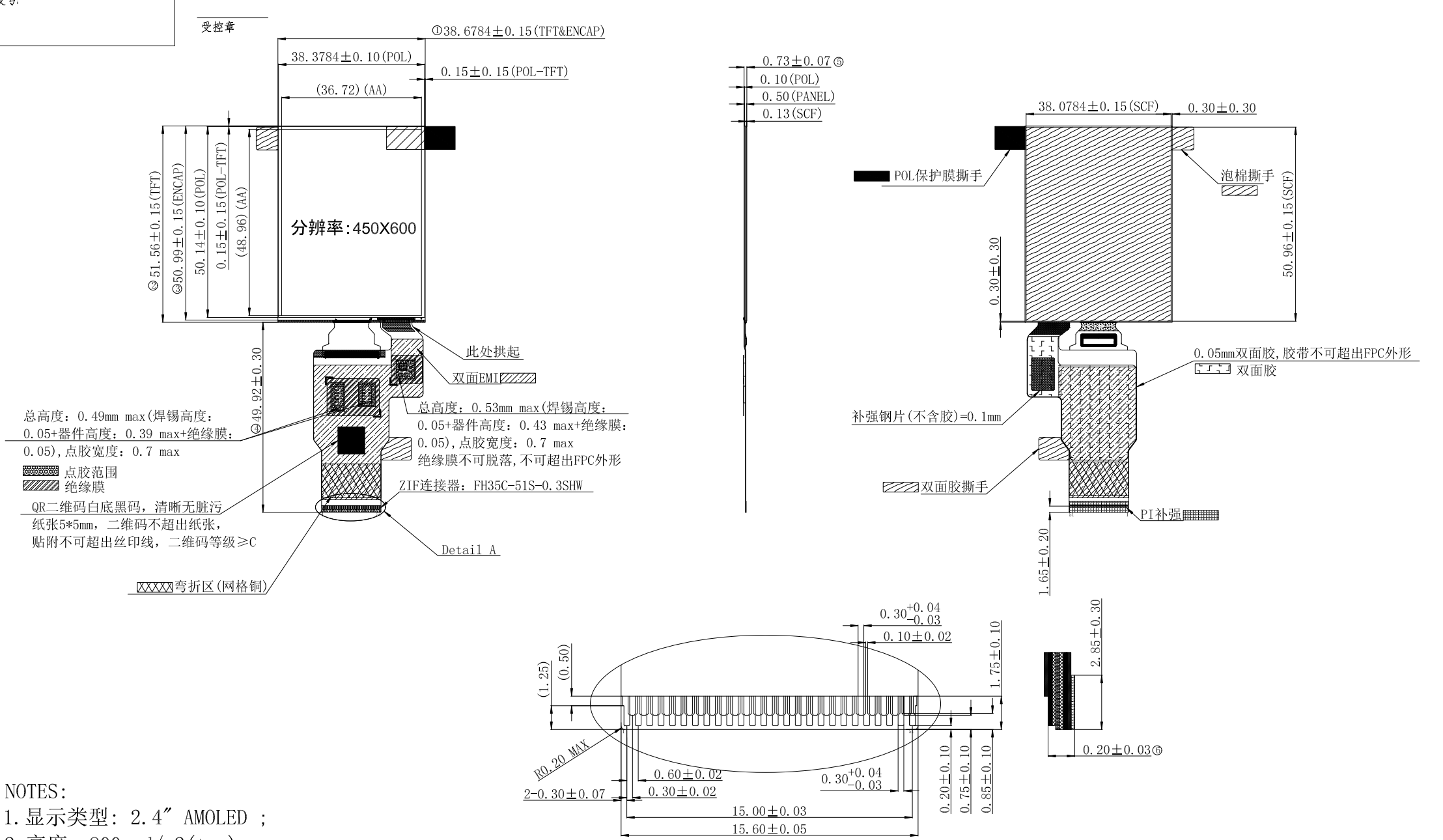
The 2.4-inch AMOLED display features a resolution of 450 x 600, a contrast ratio of 100,000:1, and utilizes an LTPS glass substrate.
The 2.4-inch TFT-LCD display features a resolution of 480 x 640 and a contrast ratio of 1,200:1.
4. Color Gamut Differences
The 2.4-inch AMOLED display covers a color gamut of 100%.
The 2.4-inch TFT-LCD display covers a color gamut of 68%. 5. Differences in Module Thickness
Since 2.4-inch AMOLED displays are self-emissive, they do not require a backlight; consequently, their overall thickness is quite slim—typically less than 1 millimeter.
In contrast, 2.4-inch TFT LCD screens require a backlight to produce an image. The thickness of the module therefore includes the thickness of the backlight unit, making it significantly thicker compared to AMOLED displays.
The two technologies differ substantially in terms of contrast ratio, color gamut, and module thickness.
If a customer has specific requirements regarding color gamut, power consumption, or brightness, the 2.4-inch AMOLED display is the recommended choice. However, for those prioritizing cost-effectiveness, the TFT option is preferable. Although 2.4-inch AMOLED displays offer numerous advantages, limitations inherent in their manufacturing processes and materials result in a significantly higher overall cost compared to TFTs—a factor that often causes customers to hesitate when deciding whether to adopt the technology. Shenzhen Hongjia Technology offers a wide selection of AMOLED screens in various sizes and with multiple interface options. We can supply units with integrated capacitive touchscreens (fully bonded) and provide a 36-month after-sales service warranty. We welcome inquiries from prospective customers via email.
Send Inquiry


X
We use cookies to offer you a better browsing experience, analyze site traffic and personalize content. By using this site, you agree to our use of cookies.
Privacy Policy