 English
 Español
 Português
 русский
 Français
 日本語
日本語 Deutsch
 tiếng Việt
 Italiano
 Nederlands
 ภาษาไทย
 Polski
 한국어
한국어 Svenska
 magyar
 Malay
Malay বাংলা ভাষার
 Dansk
Dansk Suomi
Suomi हिन्दी
What Should You Verify Before Using a 3.5-Inch 640 × 480 MIPI Display?
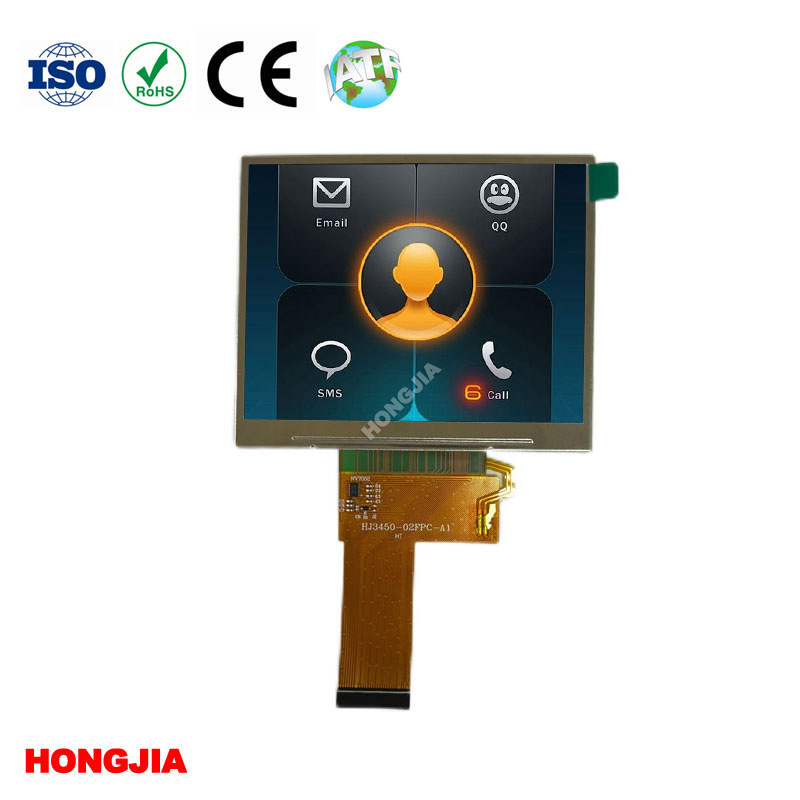
Before approving a 3.5 inch Horizontal Screen 640x480 MIPI Interface, verify five things: the actual active resolution and orientation, your host board’s MIPI requirements, the 30-pin pinout, the mechanical drawing, and the supplier’s initialization and optical documentation. HONGJIA’s HJ3450-02 may fit compact industrial, handheld, smart-home, beauty, and consumer products, but one unresolved specification can create a costly redesign.
First confirm whether HJ3450-02 is a 640 × 480 horizontal display or a 480 × 800 portrait module
The first answer is not fully settled by the published information: the product description identifies HJ3450-02 as a 640 × 480 horizontal display, while the specification table separately lists 480(RGB) × 800. Treat that discrepancy as an engineering question, not a formatting detail.
Resolve the specification conflict before sampling
Ask HONGJIA to confirm the active matrix resolution, pixel arrangement, native scan orientation, viewing direction, and the exact revision of the module being quoted. Request a current datasheet and a photo or drawing that identifies the active area. Do not infer orientation from the outside dimensions or from the connector location.
A 640 × 480 module and a 480 × 800 module can require different UI assets, framebuffer assumptions, initialization commands, and enclosure layouts. If the display is physically horizontal but the panel data is configured for portrait scanning, your software team may need rotation support. That can affect boot time, memory use, touch coordinates, and image composition.
Match the verified orientation to the product UI and enclosure
For a handheld tester or industrial control interface, horizontal space may suit trend graphs, measurement labels, and two-column controls. A portrait panel may be better for lists or vertically stacked workflows. Confirm the choice against the bezel opening, active area, viewing direction, cable exit, and mounting features before your industrial design is frozen.
Use the HJ3450-02 product page as the starting point, then obtain the controlled drawing for your quoted revision.
What the HONGJIA module offers for compact embedded interfaces
HJ3450-02 is described as a 3.5-inch IPS transmissive TFT LCD module with an NV3051F driver IC, MIPI interface, and 30-pin connection. The listed outline is 76.2 × 63.2 × 3.5 mm, and the stated operating temperature range is -20°C to 70°C. Brightness is listed as selectable up to 500 cd/m², so confirm the exact brightness bin rather than assuming every sample uses the maximum value.
IPS can help maintain more consistent color and contrast as the operator views the screen away from perpendicular. It does not remove the need to check the real viewing angle, contrast, cover-lens reflections, and readability under your product’s lighting conditions. “Transmissive” also matters: the module is intended to be viewed with backlight illumination, not as a sunlight-readable transflective panel.
The module’s size and MIPI connection make it a candidate for compact embedded systems, including handheld testing instruments, industrial equipment, medical-related equipment, beauty devices, smart-home products, POS hardware, and consumer electronics. Suitability still depends on your host processor, optical stack, enclosure, and environmental target.
Can your host board drive the 30-pin MIPI connection?
Only if the host supports the panel’s exact MIPI-DSI electrical and software requirements. A 30-pin connector describes the physical interface; it does not, by itself, tell you the lane count, lane speed, pixel format, command sequence, power rails, or backlight control method.
Verify MIPI lane count, timing, initialization commands, pinout, and connector orientation
Before layout, request the complete pin definition and confirm:
- MIPI data-lane count, clock behavior, and required data rate
- Supported pixel format, color order, and video or command mode
- Horizontal and vertical timing requirements
- Reset, standby, power-up, and shutdown sequence
- Panel supply, I/O voltage, backlight input, and backlight current range
- FPC contact side, connector orientation, cable length limits, and pin numbering
- NV3051F initialization commands and any required register settings
Common field failures are simple: the FPC is mirrored, the reset line is left floating, the host uses the wrong color order, or the display lights up without receiving valid frame data. A white screen usually does not prove MIPI compatibility. It may only prove that the backlight and panel power are present.
Have your firmware engineer test the sample with the same processor family, bridge, connector, and power sequence planned for production. If your board uses a different MIPI implementation, ask HONGJIA whether a custom FPC or initialization configuration is possible and what changes remain within the standard module design.
Which documents are needed to move from a display sample to design approval?
A sample is useful for checking image quality and fit. It is not design approval. Request a document set that lets hardware, firmware, mechanical, and purchasing teams review the same revision.
- Current product datasheet with the confirmed resolution and orientation
- Mechanical drawing showing outline, active area, viewing area, thickness, mounting details, and FPC position
- Electrical specification covering connector pinout, power, backlight, and interface conditions
- Initialization code or command sequence for the NV3051F driver IC
- Optical data for brightness, contrast, viewing direction, and uniformity where available
- Operating and storage temperature limits, plus inspection criteria for display defects
- Revision-controlled sample identification and any known differences between sample and production versions
If touch is part of the product, treat the touch panel, cover lens, adhesive, and FPC as a separate review. A display that fits before bonding may not fit after the final optical stack is specified.
Where does a 3.5-inch horizontal IPS display fit—and where might it be unsuitable?
This 3.5-inch MIPI TFT display is a sensible candidate when you need a compact color interface, a horizontal layout, and a standard embedded connection. It deserves early consideration for handheld instruments, industrial controls, beauty equipment, smart-home interfaces, and other products where enclosure volume matters.
It may be unsuitable if your product requires sunlight readability without a tested optical design, operation below -20°C or above 70°C, a transflective panel, unusually high brightness, or a portrait-only user experience. Those requirements should be stated before quoting. HONGJIA also offers other display categories, including wide-temperature and transflective products, but do not assume the HJ3450-02 provides those features.
Another practical limit is software. If your graphics stack cannot rotate or address the panel in the required orientation, changing the display late in development may force a board or UI redesign. Confirm that decision while the sample is still being evaluated.
What should a U.S. design-in team request from HONGJIA before issuing an RFQ?
Send a controlled requirement, not just a product link. State the confirmed target resolution, orientation, active area, enclosure limits, temperature range, brightness target, host processor or bridge, MIPI requirements, and intended annual demand. Ask HONGJIA to mark each item as standard, configurable, or custom.
Request samples, FPC and touch options, customization limits, and production continuity evidence
Request samples from the proposed production configuration, including the intended FPC, connector, backlight setup, and touch option if applicable. Confirm whether HONGJIA can customize the FPC, pin assignment, cover lens, touch panel, brightness, or initialization settings—and ask what minimum order, tooling, lead time, and validation work each change requires.
For a production decision, ask for evidence of supply continuity: the planned module revision, driver IC sourcing position, change-notification practice, quality inspection process, and support available from the factory or FAE team. Do not request certifications or test reports as a formality; identify which standards your finished product actually requires and ask for the relevant documentation.
Use HONGJIA’s 3.5-inch horizontal MIPI display information to begin the technical discussion, then make the RFQ conditional on resolving the 640 × 480 versus 480 × 800 conflict. The right next step is a documented sample review—not a purchase order based on an ambiguous table.
Send Inquiry


X
We use cookies to offer you a better browsing experience, analyze site traffic and personalize content. By using this site, you agree to our use of cookies.
Privacy Policy