 English
 Español
 Português
 русский
 Français
 日本語
 Deutsch
 tiếng Việt
 Italiano
 Nederlands
 ภาษาไทย
 Polski
 한국어
 Svenska
 magyar
 Malay
 বাংলা ভাষার
 Dansk
 Suomi
 हिन्दी


The black electromagnetic shielding film on display ribbon cables is far more powerful than you might imagine.
An increasing number of clients are requesting the addition of a black electromagnetic shielding film to the surface of their LCD ribbon cables. Don’t be fooled by its thin, unassuming appearance—this is an EMI (Electromagnetic Interference) shielding film for FPC (Flexible Printed Circuit) cables, and it is far more capable than most people realize. It is not merely a coat of black paint; its standard construction consists of a PET protective layer, a black insulating layer, a sputtered metal layer (copper/silver alloy), a conductive adhesive layer, and a release liner. The black color is simply an outer insulating pigment; the real work is done by the nano-scale metal layer in the middle. Crucially, this layer must be grounded to function—if left ungrounded, it can actually act as an antenna, making interference worse rather than better.
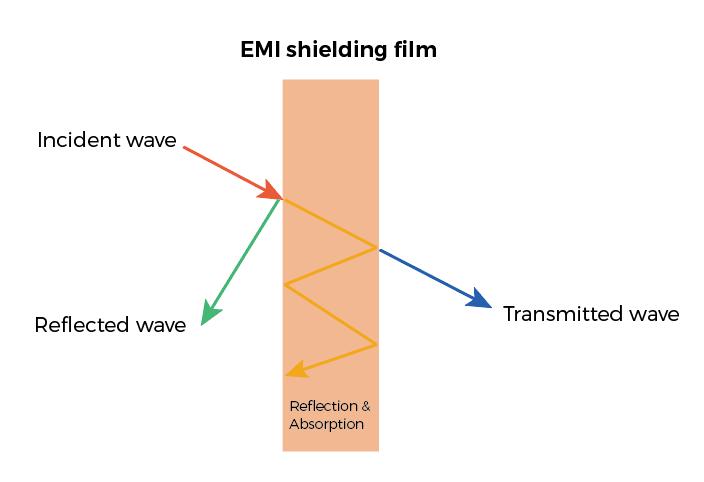
Today, Engineer Liu from Shenzhen Hongjia Technology explains four key functions of this film:
1. Blocking external interference: High-speed LVDS/MIPI signals in displays are extremely sensitive. If noise from the motherboard, wireless modules, or power supply leaks in, it can cause horizontal lines, screen flickering, or visual artifacts. The shielding film reflects and absorbs electromagnetic waves, preserving signal integrity—which is the primary reason it has become a standard feature on LCD ribbon cables.
2. Containing internal radiation: High-speed differential signal lines within the ribbon cable can act like antennas. The shielding film traps this radiation, preventing it from interfering with other circuits on the motherboard. It also ensures the entire device meets EMC (Electromagnetic Compatibility) and wireless certification standards—a necessity for everything from smartphones to automotive displays.
3. High-performance shielding: Standard versions can achieve 60 dB of shielding effectiveness, while high-end models can reach 75–80 dB—meaning they attenuate electromagnetic waves to one ten-thousandth or even one one-hundred-thousandth of their original intensity. Despite this, the film is only a dozen microns thick. It must withstand repeated bending, reflow soldering, and exposure to solvents, all while maintaining precise impedance control. Due to these high technical requirements, the market was long dominated by a few Japanese manufacturers.
4. Protection: It provides anti-static properties, offers minor scratch resistance, and protects the copper traces underneath. However, it is not a generic protective film, nor should it be treated as simple insulating tape to be applied haphazardly.
There is a noticeable difference in signal quality when driving a MIPI display using a standard flexible printed circuit (FPC) versus one equipped with an EMI-shielding layer. During display repairs, technicians sometimes remove this black film; while the screen may still light up initially, this often leads to complex, hard-to-diagnose issues—such as high-frequency interference, screen flickering, erratic touch response, or signal loss in wireless connectivity. Therefore, whenever possible, it is advisable to incorporate a black EMI-shielding film into the FPC design, as it significantly enhances the reliability and durability of the LCD screen.
Adding a black EMI-shielding film to an FPC does increase production costs. At Shenzhen Hongjia Technology, we offer FPCs for various displays—some featuring this black EMI-shielding film, others without. We also provide custom solutions tailored to specific client requirements; we welcome inquiries via email.
Send Inquiry


X
We use cookies to offer you a better browsing experience, analyze site traffic and personalize content. By using this site, you agree to our use of cookies.
Privacy Policy